



You are three weeks into a product launch. The landing page needs a redesign, your social media queue is empty, the sales deck looks like it was made in 2017, and your paid ads are still running creatives from last quarter. You open your laptop to fix it and immediately hit the same wall you always hit: no one to do the work, no time to do it yourself, and no budget to throw at an agency that will take two weeks just to onboard you.
This is not a rare situation. It is what marketing at a growing company actually feels like most of the time. Design is always needed, always behind, and always either too expensive or too slow to get right.
Why does graphic design matter more than most founders think?
Before getting into the solution, it is worth understanding why design keeps showing up as a problem in the first place.
Graphic design is not decoration. It is how your business communicates without words. When someone lands on your website, they form an opinion in about 50 milliseconds, well before they read a single sentence. That first impression is built entirely from visuals: your layout, your colours, your fonts, and the way your hero image is framed.
The same logic applies everywhere. Your LinkedIn ad competes with hundreds of other posts in a feed. Your pitch deck sits on a table next to three others. Your product packaging is on a shelf next to your competitor's. In every single one of those moments, design is either working for you or against you.
.jpg)
Good design tells a story before the reader even starts reading
The most effective design does not just look good. It moves people through a feeling and toward a decision. Think about the way Notion lays out its homepage: clean, calm, and confident. Or the way Figma uses bright colour and bold type to signal energy and creativity. Or how Linear keeps everything minimal and precise because their whole brand is about focus. None of that is accidental. Every visual choice is a story being told without a single word.
This is why businesses that invest in design as a strategic capability often outperform their competitors. McKinsey found that companies with strong design practices outperformed industry peers by 32 percentage points in revenue growth over a five-year period. Design is not just a cosmetic exercise. It can be a meaningful driver of business growth.
But here is the problem: most growing businesses cannot afford to build the kind of in-house design team that produces that level of consistency. A senior designer in the US costs between $85,000 and $120,000 a year in salary alone, before benefits, tools, and management time. And one designer can only move so fast when your business needs 30 to 50 new design assets every single month.
This is where unlimited graphic design comes in
Unlimited graphic design is a subscription model where you pay one flat monthly fee and get access to a team of designers who work through your requests on demand. You submit a request, a designer picks it up and delivers a finished asset within 24 to 48 hours, and you move straight to the next one. There is no per-project billing, no freelancer hunting, no agency retainer, and no waiting for a contract to be signed before work begins.
The model works like a queue. You add requests, designers work through them one at a time (or multiple at once on higher plans), and you get a steady output of finished design work as long as your subscription is active. Social media graphics, ads, pitch decks, logos, email templates, landing page mockups, packaging, infographics, and motion graphics: most unlimited design services cover more than 100 different types of work.
What it does not replace is strategic brand direction or complex web development. It is not a full creative agency. It is a production engine for businesses that already know what they want to say and need help saying it visually, fast, and at volume.
.jpg)
How it compares to every other option
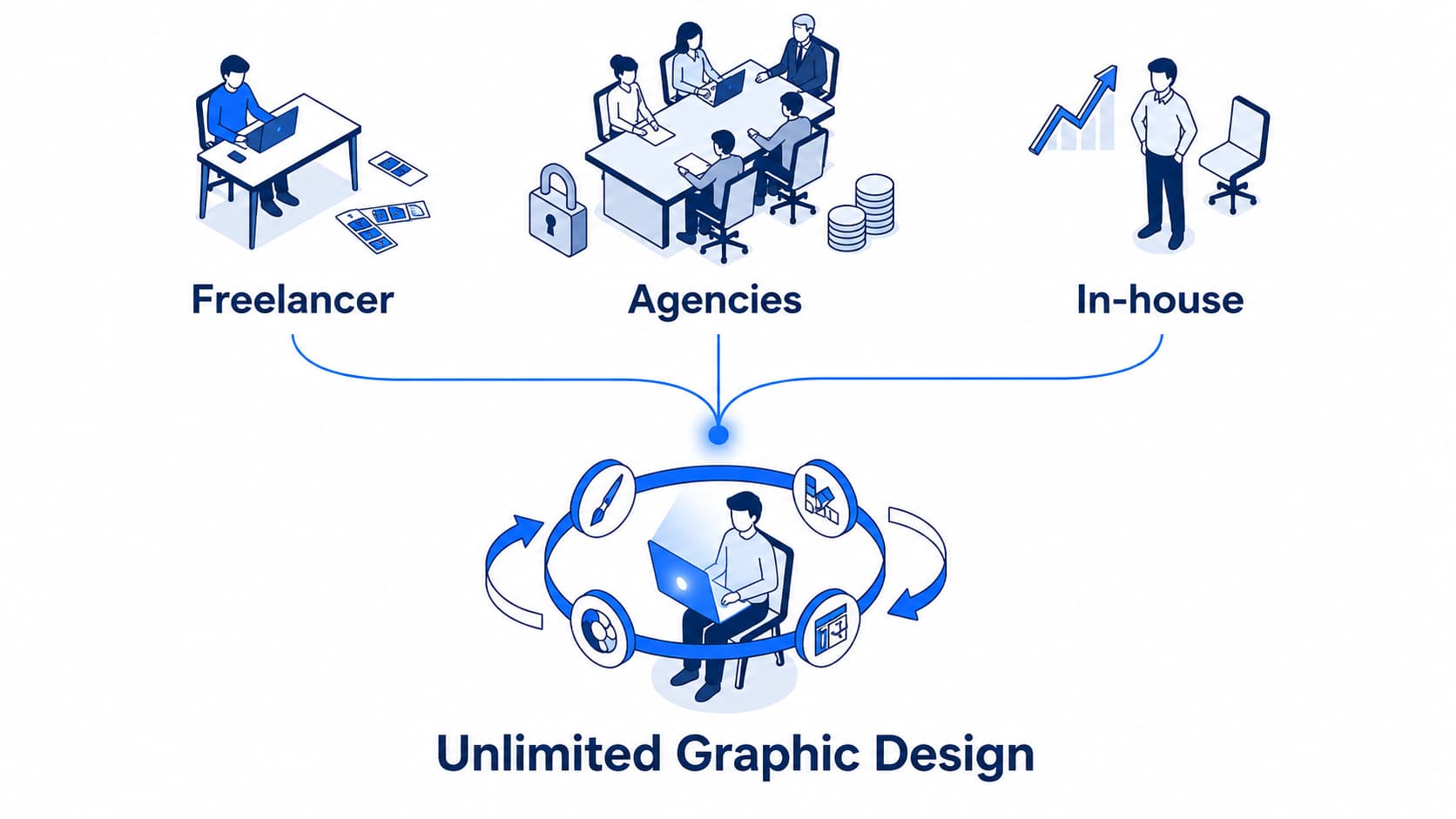
Most businesses try three things before landing on a subscription service, and each one has a real cost that does not show up in the invoice.
Freelancers feel cheap at first. You pay per project, and you are only paying when you need something. But the hidden costs add up fast. You spend time finding someone, briefing them, managing revisions, and hoping the quality is consistent. And every new freelancer starts from zero on your brand. They do not know your colours, your tone, or your rules. You end up spending more time on design than you saved by outsourcing it.
Agencies feel like the professional option. You get a real team, a real process, and real quality. But agency retainers in the US typically start at $3,000 to $5,000 per month; onboarding takes weeks, and the contract locks you in for six months minimum. For a company that is still finding its footing, that is a lot of commitment for work that might need to change direction next quarter.
Hiring in-house sounds like the long-term answer. And for some businesses it is. But one designer cannot scale with high-volume needs, a senior hire costs over $100,000 a year, and if they leave, you are back to square one.
An unlimited graphic design service gives you the consistency of in-house, the speed of on-demand, and the cost of a single mid-level tool subscription. Most services in the US are priced between $500 and $1,500 per month. At 30 assets a month, that works out to $17 to $50 per finished design, which is a fraction of what any freelancer would charge for the same work.
Is it actually worth it?
The honest answer is yes, if your volume justifies it.
If you are producing fewer than ten design assets a month, a subscription is probably more than you need. You are better off paying a freelancer per project.
But if you are running paid ads, posting on social media consistently, updating your website regularly, building sales collateral, and sending email campaigns, you are almost certainly producing 30 or more assets every month. At that point, the subscription pays for itself within the first few weeks and keeps paying as long as you stay subscribed.
The other thing that compounds over time is brand consistency. When the same designers work on your account month after month, they learn your style. The briefs get shorter. The revisions get fewer. The output gets better. That is not something you get from rotating freelancers.
Where Minute Creative fits into this
For fast-moving SaaS teams, design is often the bottleneck. Campaigns are slow because assets are not ready. The brand looks different everywhere it shows up. And the positioning work your team spent weeks getting right never quite makes it into the pitch deck, the ads, or the one-pager.
At Minute Creative, unlimited graphic design is built into how we work. That means the positioning shows up consistently in every asset your team ships, from the homepage to the sales deck to the LinkedIn ads, without the back and forth of briefing a freelancer every time something needs to go out the door.
.jpg)
.png)